
Physiotherapy

Spiral stabilization - SM system
It is a method focusing on promoting correct posture. Its principle is the activation of 3 basic muscle spirals with the help of an elastic rope. It is aimed at exercising with patients with pain in all areas of the spine, severe disc prolapse, scoliosis and large joint pain.
The aim of spiral stabilisation is to tension and stretch the spine upwards and to subsequently reduce the pressure acting on the intervertebral discs. It compensates for the negative effects of an inappropriate movement stereotype, whether in the case of insufficient movement or, on the contrary, unhealthy and excessive loading. It uses coordination, stabilisation, mobilisation, strengthening and stretching exercises.
Benefits – relaxes overloaded muscles, strengthens weakened muscles, restores spinal balance,
relieves tension in the cervical spine, headache, migraine.
Indications – herniated discs, scoliosis, arthrosis, functional musculoskeletal disorders, flat feet,
pregnancy, complications after spinal surgery, acute and chronic back pain, incorrect posture.

Rehabilitation - shoulder, elbow and hand
Rehabilitation is a complex, coordinated and targeted process of regaining the functionality of the musculoskeletal system of patients after injuries or surgical interventions.
Benefits – regaining functionality, reducing pain and sensitivity, increasing mobility and mobility, supporting the healing process of post-operative and post-traumatic conditions.
Indications – shoulder arthroscopy, post-operative pain, shoulder dislocation, after fractures, after injuries, tennis elbow, golf elbow.
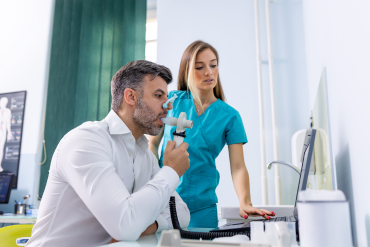
Respiratory therapy
It is a grouping of breathing rehabilitation techniques. It is designed for patients after acute respiratory disease and alleviates the effects of chronic lung disease.
Benefits – modification of breathing stereotype, training of upper and lower respiratory tract hygiene, resistive inhalation and exhalation exercises, increase in lung vitality and capacity.
Indications – post covid syndrome, chronic bronchitis, asthma, conditions after overcoming pneumonia, difficult breathing, prolonged cough, nausea, chronic fatigue, sleep disorders, psychosomatic conditions.

Bobath in applied therapy
Bobath’s concept is a diagnostic and therapeutic approach oriented towards solving the problems of patients with impaired movement function and postural control caused by CNS lesions, e.g. after stroke, multiple sclerosis, after brain injuries.
Benefits – prevention of abnormal movement patterns and deformities.
Indications – central movement disorders, hemiplegia ( CMP ), multiple sclerosis.

Fascial therapy
It is a special type of manual therapy that focuses on treating and improving the condition of fascia in the body. Fasciae are thin, flexible and strong connective tissues that surround and support most of the structures in our body, including muscles, bones, organs and nerves. It focuses on identifying and removing restrictions, tension and imbalances in these fasciae, which can lead to a variety of physical and emotional problems. Gentle touches and movements are performed on the surface of the skin and are gentle and non-invasive. The manipulations are aimed at restoring flexibility, hydration and elasticity to the fascia, helping to eliminate pain, improve mobility and promote the patient’s overall health and well-being.
Benefits – pain relief, improved mobility, stress reduction, improved body mobility, and promotion of emotional health.
Indications – back, neck and shoulder pain, joint problems, post-traumatic rehabilitation, chronic muscle and joint pain, migraine and headaches, movement and posture disorders, emotional and stress problems, conditions associated with chronic tension and stress.

Flossing - Floss band
This is a specific bandaging technique, the main goal of which is to improve the range of motion in the joint area, significantly reducing and in many cases completely eliminating pain. It is used as an adjunctive treatment after surgical procedures of peripheral joints, in their mobilization, in the treatment of adherent scars, etc. The treatment begins with wrapping the tape on the treated area, which is subjected to compression for a while. This momentarily prevents the blood and nutrients from flowing to the treatment site. Under the influence of compression, we begin to make movements with the treated limb, which ensures friction between the muscle fibres, fascial tissue and the subcutaneous layer, where the tape helps to loosen the tissue adhesions, remove lactic acid and other waste substances even in the most inaccessible places of the treated area. After unwinding the tape, the so-called sponge effect occurs, which guarantees the supply of new blood and nutrients necessary for the physiological functioning of the segment. The procedure is repeated in a number of steps individually chosen by the therapist according to the type of diagnosis, the current stage of healing and the patient’s state of health.
Benefits – reduced soreness, improved blood circulation, mobility, regeneration of muscle tissue, tendons and joints.
Indications – tennis elbow, golf elbow, painful tendon tears of muscles, muscle strains, ankle sprains, stiff muscles, heel spur, Achilles tendon pain, knee, ankle, wrist pain, conditions after arthroscopy of joints, scars.

Manual therapy
Traction – Traction means pulling or stretching. It is a passive procedure that uses mechanical force to stretch soft tissues (muscles, ligaments, tendons, joint capsules). The essence of this method is the use of traction in the horizontal plane or inclined plane. The aim of traction is to loosen shortened and stiff fascia and muscles of the spine. Traction is used in cervical spine, lumbar spine and sacral spine disorders. Cervical spine tractions are performed using a cervical cuff, where we make a pull in the cervical spine . Sacral spine tractions are done using the lumbar girdle when the thrust is in the lumbosacral spine. LS (lumbosacral spine) tractions can also be applied using ankle cuffs.
Manipulations – These are gentle and precise impact techniques to loosen stiff joints, following mobilisation. It is important to relax the patient as much as possible. Joint manipulation should not be done forcefully. We may or may not hear a snap when loosening. These techniques should be performed by an erudite professional, preferably an FBLR physician or a physiotherapist.
Benefits – release of muscle tension, gradual pain relief, allows the damaged disc or joint to return to its proper location, stretching of the intervertebral joints occurs and the space for the nerve to run freely is increased without mechanical irritation.
Indications – spinal pain, sciatica, herniated disc, other conditions associated with spinal and muscle tension.

Kinesio Tape
Taping, also called kinesiotaping, is a therapeutic method using special elastic bands. These are taped to the surface of the body to support the musculoskeletal system, improve blood circulation and relieve pain.
Benefits – improving muscle function, affecting muscle tension, increasing muscle stability, promoting the healing process, improving the lymphatic system and circulatory system, increasing joint stability, eliminating the inflammatory process, reducing swelling and local soreness.
Indications – muscle pain (myalgia), neuralgia, joint instability, vertebro-algic syndrome, peripheral and central paresis, swelling, arthrosis, degenerative processes, insufficient lymph drainage, scar care.